
Part 6 of a series: The Rise of AI-native Outcome Integrators
A traditional System Integrator is looking at a RFI that just dropped related to their existing work. It is asking unexpected questions like…
- What (mission specific) operational capabilities can you demonstrate in two weeks?
- How do you use AI to reduce operational overhead and delivery timelines?
- Describe your human-to-automation operational ratio.
- Can this capability be delivered as a managed operational service or SaaS solution?
- Can this capability be delivered under a firm fixed-price structure?
- Describe your operational expertise in this mission area.
- How do you ensure operational oversight of AI agents and automation workflows?
- What operational savings can be achieved through AI-native delivery?
- How much reduction in staffing overhead is achievable?
- What pricing efficiencies are enabled through workflow automation?
- Can your organization participate in rapid pilot or advisory down-select acquisition models?
These questions have the incumbent concerned because they signal a market shift away from their business and operations model – and they are not prepared to compete. Expect versions of this story to become increasingly common over the next few years.
The good news for traditional GovCon firms is that many still retain major advantages, including customer relationships, government technology expertise, contract access, operational experience, and deep acquisition knowledge. The challenge is that those advantages alone will not be enough if the organization refuses to evolve operationally. This shift cannot be treated as a small innovation initiative buried inside the company – it requires structural change in how the organization delivers, operates, and competes.
In The Innovator’s Dilemma, Clayton Christensen argued that disruptive innovation often fails inside incumbent organizations because the new model gets crushed by the economics, incentives, culture, and operational assumptions of the existing business. That lesson applies directly to GovCon.
To compete, traditional GovCon firms should…
1. Create a Separate AI-Native Outcome Integrator Division
Do not try to merge AI-native delivery into the existing staffing-based production floor. It will fail.
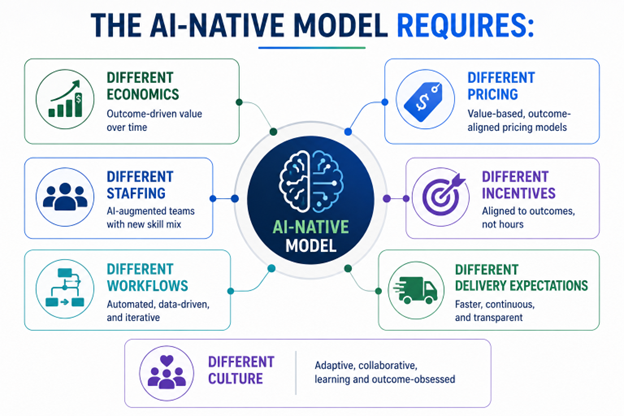
Organizations attempting to compete in the AI-native marketplace should strongly consider creating a separate AI-native division empowered to operate differently. That division must be protected from traditional utilization pressure, staffing metrics, proposal-heavy operations, and legacy delivery governance that were designed for labor-based delivery models.
Equally important, traditional delivery teams should be protected from disruption while the new model matures. This is not simply a process optimization effort inside an existing structure – it is the creation of a parallel operating model with different economics, workflows, incentives, and delivery expectations.
2. Build a Commoditized Service Pricing Model Menu
Traditional GovCon pricing models are heavily tied to labor categories and hours. AI-native delivery changes that, creating productized service offerings where Government buyers can purchase operational capability in clearly defined units of work like:
- Workflow automation packages
- Operational dashboards
- AI-assisted intake systems
- Managed AI operations
- Reporting modernization
- Domain-specific operational workflows
AI-native delivery models should make pricing simple, transparent, repeatable, and more commercial-like. This naturally aligns with firm fixed-price contracts, managed services, rapid purchasing models, and continuous delivery approaches that focus on operational outcomes instead of labor hours.
In some cases, productized AI-native operational services may fit well under Other Direct Costs (ODCs) when integrated into existing contracts. Avoid Time & Materials structures whenever possible for AI-native operational delivery, because T&M often implies Government management of individual workers and internal workflows. That model breaks AI-native operational delivery. An AI-native Outcome Integrator is not selling staffing oversight. It is selling operational outcomes.
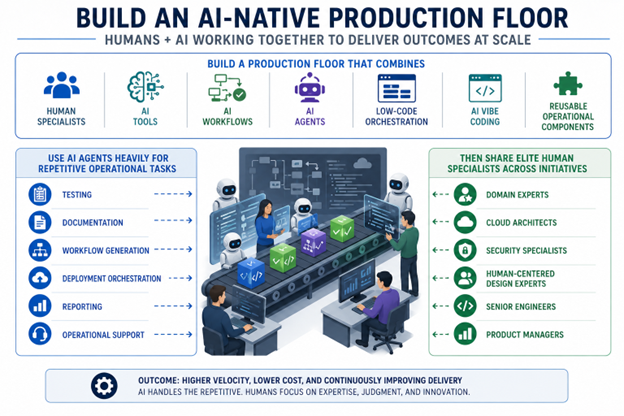
3. Build an AI-native Production Floor
The future delivery organization is not: humans replaced by AI. It is: humans orchestrating AI-native operational systems. The future operational model is smaller, flatter, faster, and more specialized.
4. Elevate Product Management
Traditional GovCon delivery models often treat product management as secondary to contracts and project execution. That must change. In AI-native delivery environments, product leaders increasingly become operational owners responsible for prototypes, user outcomes, workflow improvement, service optimization, operational evolution, ethical AI governance, and roadmap prioritization. Product management becomes the operational center of gravity driving continuous improvement and measurable outcomes.
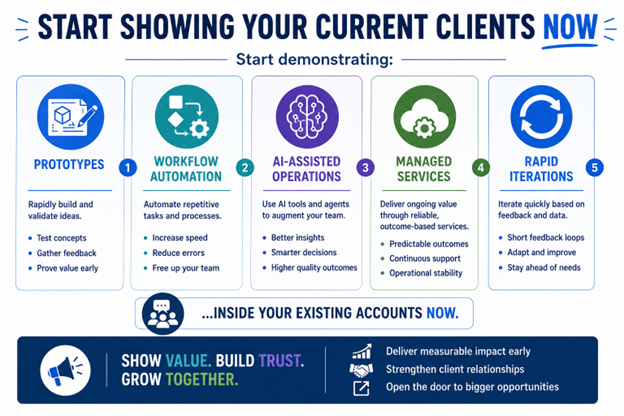
5. Start With Existing Customers Immediately
Do not wait. If your current customers do not see you operating in an AI-native way today, they will not believe you can do it tomorrow. That creates enormous recompete risk. Yes, this will likely disrupt your current economic model. Do it anyway. Because somebody else eventually will.
6. Build “Show Me” Capabilities
The future GovCon marketplace increasingly rewards demonstrations, operational prototypes, live workflows, and measurable outcomes over generic capability matrices, massive slide decks, and proposal theater. Agencies want to see operational value proven quickly – not simply described in lengthy proposals.
Organizations should train themselves to rapidly demonstrate operational capability inside existing engagements and acquisition processes. Firms that can show value quickly through working systems, automation, and measurable outcomes will increasingly outperform firms that mainly describe value through traditional proposal-driven approaches.
7. Keep Humans in the Loop
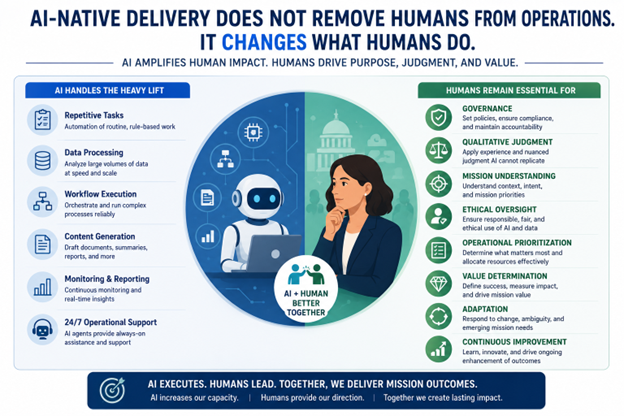
The strongest AI-native operational models are human-guided systems where AI continuously assists, automates, and accelerates – while experienced humans constantly oversee, correct, improve, and adapt the operational environment. That human operational feedback loop becomes one of the most important competitive advantages in AI-native delivery.
8. Accept That the Market Is Already Changing
Many traditional GovCon firms still believe this transition is years away.
It is already happening. Acquisition reform, AI-native delivery, workflow automation, zero trust, managed services, and operational accountability are all moving in the same direction:
- Smaller teams
- Faster delivery
- Lower costs
- Continuous operations
- Measurable outcomes
The organizations that move aggressively now still have a major opportunity to lead. The organizations that wait for certainty will likely spend the next several years wondering why recompetes stopped feeling safe.
The government buying ecosystem is rapidly changing. AI-native Outcome Integrators are already emerging, and citizen demand for more customized, mission-focused outcomes at scale is accelerating the shift. This will drive a tipping point in the GovCon market, moving away from traditional staffing-based consulting toward AI-native, outcome-based delivery models. This is not an incremental evolution. It is a structural leap in how government services are designed, delivered, and measured. The economic pressure fueling the leap is too great to ignore. The time to prepare is now.
Part One: The End of the Traditional GovCon System Integrator
Part Two: Inside the AI-Native Public Sector Delivery Factory
Part Three: Why Federal Acquisition Reform Favors AI-Native Outcome Integrators
Part Four: Why Mission & Domain Expertise Will Matter More Than Technical Expertise
Part Five: Faster Government, Better Services, Lower Cost
About Greg Godbout
Greg Godbout is an AI and digital transformation executive helping government contractors and public sector organizations adopt and scale AI. He is the CEO of Flamelit, an AI and Data Science consultancy, and AI for Natural Disasters, an emergency response AI technology company. Both were recently acquired by Global Clean Energy, Inc. Previously, Greg served as Chief Growth Officer at Fearless, Chief Technology Officer and U.S. Digital Services Lead at EPA, and was the first Executive Director and Co-Founder of 18F. He is a Presidential Innovation Fellow, GSA Administrator’s Award recipient, and Federal 100 honoree. Greg holds master’s degrees from the University of Virginia and New York University in technology management, business analytics, and AI.