
Part 5 of a series: The Rise of AI-native Outcome Integrators
A traditional System Integrator proposes a three-year modernization roadmap focused on gradually integrating AI after the agency modernizes its government run technology factory. Meanwhile, an AI-native Outcome Integrator proposes a managed service using their modernized and government approved secure technology factory that delivers the first operational system in three months at a fraction of the cost, with continuous monthly improvements built in. Before the traditional integrator can even begin implementation, the AI-native solution has already evolved through dozens of real-world iterations – with better outcomes at roughly 60% to 70% of the cost. Expect versions of this story to become increasingly common over the next few years.
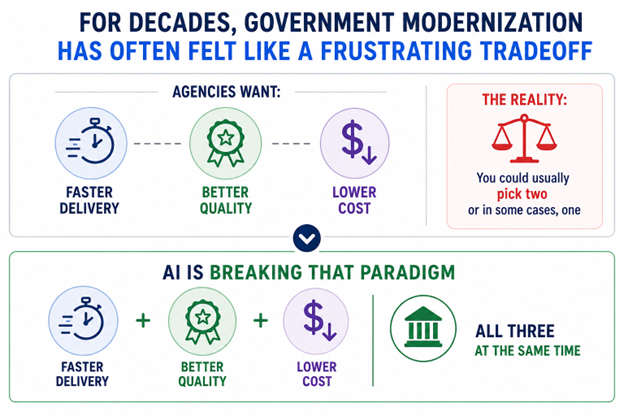
The rise of AI-native operational delivery, AI agents, low-code orchestration, and workflow automation is creating the possibility of something the Government has historically struggled to achieve at scale: Faster services. Better outcomes. Lower operational costs. At the same time.
This is not simply about writing software faster. It is about transforming how public services themselves are designed, delivered, and continuously improved.
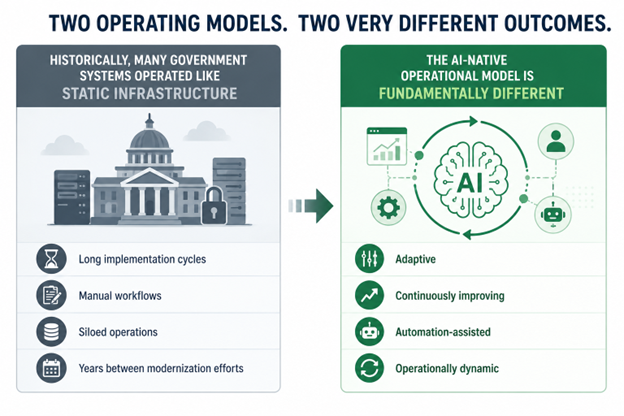
Speed matters because public services themselves are increasingly becoming dynamic systems rather than static applications. Deloitte recently described the future of government as operating through “continuous learning systems” with adaptive oversight, embedded feedback loops, predictive operations, and continuously evolving digital services.
AI is also enabling something that has historically been extremely difficult in Government delivery: mass customization. Mass customization is the ability to deliver highly tailored services at scale without dramatically increasing operational cost. Historically, organizations were forced to choose between speed, quality, and cost – now you can pick all three at scale.
AI-native system delivery is increasingly enabling mass customization through AI-assisted engineering, workflow automation, reusable operational components, and continuous learning systems. McKinsey describes AI-centric organizations as achieving major reductions in operating costs while simultaneously accelerating delivery velocity and enabling more adaptive customer experiences.
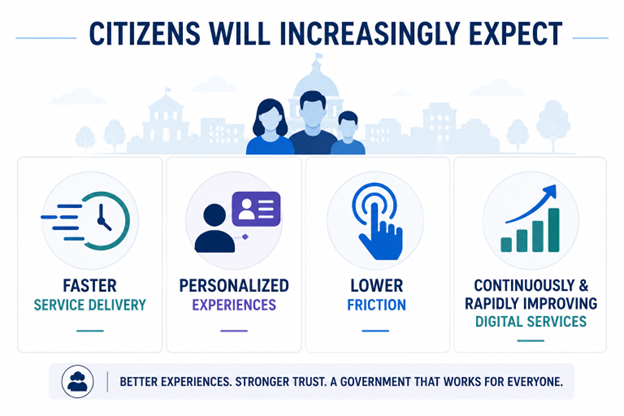
Increasingly and more frustrated, citizens will wonder why Government services aren’t easier. This shift also changes the economics of GovCon delivery itself. (The End of the Traditional GovCon System Integrator) The advantage is not simply lower labor cost. It is the ability to continuously improve operational outcomes while reducing delivery friction at the same time.
The government increasingly wants measurable outcomes, faster modernization, lower operational costs, reduced delivery risk, and better citizen services – not larger staffing charts. The Information Age optimized Government around managing systems and information flows. The emerging AI-native Intelligence Age increasingly optimizes government around continuously learning, adapting, and improving operational outcomes. Driving the government towards mass customization. The AI-native Outcome Integrators are better suited to deliver speed, quality, and price at scale.
Part One: The End of the Traditional GovCon System Integrator
Part Two: Inside the AI-Native Public Sector Delivery Factory
Part Three: Why Federal Acquisition Reform Favors AI-Native Outcome Integrators
Part Four: Why Mission & Domain Expertise Will Matter More Than Technical Expertise
About Greg Godbout
Greg Godbout is an AI and digital transformation executive helping government contractors and public sector organizations adopt and scale AI. He is the CEO of Flamelit, an AI and Data Science consultancy, and AI for Natural Disasters, an emergency response AI technology company. Both were recently acquired by Global Clean Energy, Inc. Previously, Greg served as Chief Growth Officer at Fearless, Chief Technology Officer and U.S. Digital Services Lead at EPA, and was the first Executive Director and Co-Founder of 18F. He is a Presidential Innovation Fellow, GSA Administrator’s Award recipient, and Federal 100 honoree. Greg holds master’s degrees from the University of Virginia and New York University in technology management, business analytics, and AI.