
Part 3 of a series: The Rise of AI-native Outcome Integrators
A traditional incumbent System Integrator responds to an RFI with a safe capabilities document built around familiar approaches, expecting the RFP to follow. It never does. Instead, the agency uses a private invite competition after the market research phase. AI-Native Outcome Integrators delivered domain-specific prototypes and pricing estimates at 60%-70% of the current budget – and got the invite. The incumbent never made the down-select. Expect versions of this story to become increasingly common over the next few years.
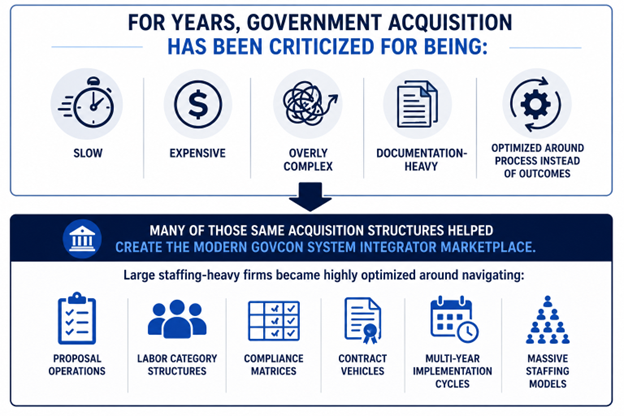
Historically, success in GovCon often depended as much on acquisition machinery as delivery capability. That is beginning to change (White House) as the government is increasingly shifting from buying labor to buying outcomes through fixed-price and performance-based contracts focused on measurable results, operational accountability, and delivery performance. This shift strongly favors AI-Native Outcome Integrators (Reference second article: Inside the AI-Native Public Sector Delivery Factory) built around automation, managed services, and outcome-driven delivery models.
Small AI-enabled teams can now produce work that previously required much larger delivery organizations. AI-assisted engineering, AI agents, low-code orchestration, and workflow automation are compressing timelines, reducing staffing needs, and creating major pressure on traditional labor-heavy contracts. Once agencies see similar or better outcomes delivered faster, with more automation and lower cost, the market will shift quickly. (Reference first article: The End of the Traditional GovCon System Integrator)
That is why Federal acquisition is increasingly moving toward:
- Fixed-Price Delivery: (GAO) Federal acquisition as shifting from specifying how contractors perform work toward specifying measurable acquisition outcomes through performance-based acquisition methods and a preference for firm-fixed price contracts.
- Managed Services: FedTech Magazine recently wrote that “managed services support modernization” by giving agencies access to advanced technologies, operational expertise, and improved security while reducing the burden of internally managing increasingly complex IT environments.
- Operational Accountability and Performance Based Contracting: US Naval Institute stated that, “Government program managers describe the results they seek to achieve, rather than tell the contractor how to do the work.”
- “Show Me” vs “Tell Me” Proposals: Steven Kelman described the rise of “tech demos,” live demonstrations, competitive prototyping, and operational proof as a major shift in government contracting toward “show me, don’t tell me” acquisition approaches.
- Private Invites off of an RFI: Washington Technology reported that “USPTO issued a request for information and said that based on responses to the RFI, it would select a pool of companies that it would invite to bid.”
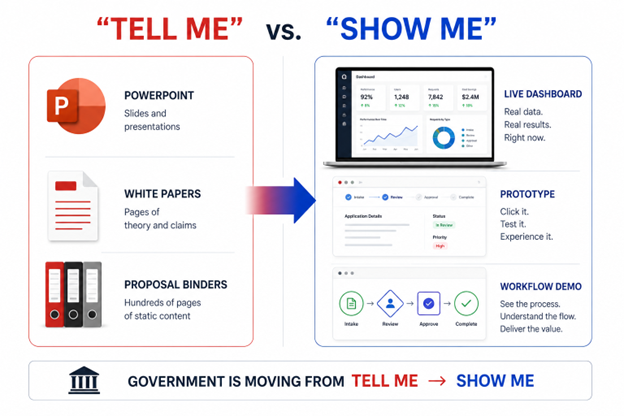
Traditional System Integrator Incumbents spend weeks producing polished white papers, proposals, and slide decks asking for money to prove they can deliver AI capabilities. Meanwhile, AI-native Outcome Integrators increasingly arrive with working prototypes already deployed – during the RFI phase. Expect that dynamic to accelerate.
Federal acquisition reform is no longer theoretical. Recent Executive Orders (Acquisition.gov) directed agencies to rewrite and streamline the FAR by removing non-essential provisions and modernizing procurement processes, leading to the launch of the “Revolutionary FAR Overhaul (RFO)” initiative.
At the same time, Zero Trust architecture enables more secure cloud-native and managed service delivery models, reducing the need for agencies to manage every layer of the technology production floor internally.
Meanwhile, Government workforce challenges continue growing. Many agencies are losing institutional knowledge faster than they can replace it, increasing dependence on external operational partners.
Increasingly, the winners will not be traditional labor-based System Integrators. They will be AI-Native Outcome Integrators.
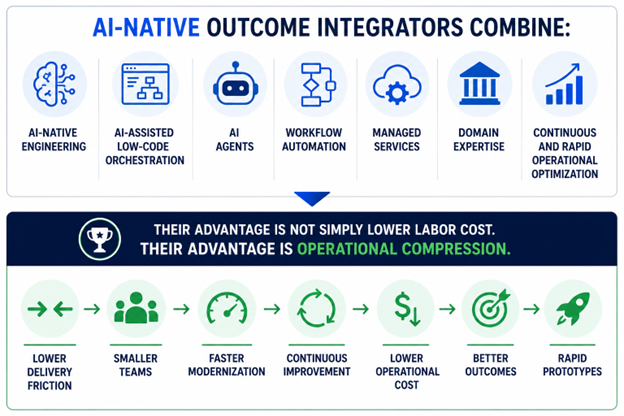
That aligns directly with where Federal acquisition is heading. The government does not ultimately want larger contractor staffing charts – it wants faster modernization, lower operational costs, better citizen services, measurable outcomes, and reduced delivery risk. AI-Native Outcome Integrators are structurally designed to deliver exactly that – through automation-first operations, smaller specialized teams, and continuous operational improvement. Traditional GovCon System Integrators are not optimized as a business to respond to and make money under the new Federal Acquisition reforms – clearing the path for the rise of the AI-native Outcome Integrator.
Part One: The End of the Traditional GovCon System Integrator
Part Two: Inside the AI-Native Public Sector Delivery Factory
About Greg Godbout
Greg Godbout is an AI and digital transformation executive helping government contractors and public sector organizations adopt and scale AI. He is the CEO of Flamelit, an AI and Data Science consultancy, and AI for Natural Disasters, an emergency response AI technology company. Both were recently acquired by Global Clean Energy, Inc. Previously, Greg served as Chief Growth Officer at Fearless, Chief Technology Officer and U.S. Digital Services Lead at EPA, and was the first Executive Director and Co-Founder of 18F. He is a Presidential Innovation Fellow, GSA Administrator’s Award recipient, and Federal 100 honoree. Greg holds master’s degrees from the University of Virginia and New York University in technology management, business analytics, and AI.