Part 2 of a series: The Rise of AI-native Outcome Integrators
A traditional incumbent System Integrator spends days creating a polished white paper proposing AI automations for their existing Government client – asking for funding to prove they can deliver. Meanwhile, an unknown competitor, an AI-Native Outcome Integrator, shows a working prototype customized for the same agency in two days, proving they already can deliver. The incumbent loses credibility with one of their most trusted clients. Expect versions of this story to become increasingly common over the next few years.
For decades, Government digital delivery looked roughly the same.
Large teams. Long timelines. Heavy coordination. Complex governance. Manual workflows. Countless meetings about other meetings.
Somewhere in the middle of all that, software occasionally appeared. That operating model is now being rebuilt from the ground up. What many people still think of as “AI-assisted software development” is actually something much larger: the emergence of an AI-native digital production floor for public sector delivery.
And once you see it, it becomes difficult to unsee.
A relatively small AI-enabled team can now produce work that previously required much larger delivery organizations. Coinbase recently described AI enabling “one-person teams,” while multiple industry analyses have highlighted how AI-native organizations are restructuring around dramatically smaller, more automated delivery teams.
AI agents are no longer just helping developers write code faster or low-code systems configure workflows faster – they are increasingly generating tests, automating workflows, documenting systems, orchestrating deployments, and supporting operational delivery. The result is that the entire digital production floor is compressing. This is bigger than a productivity improvement.
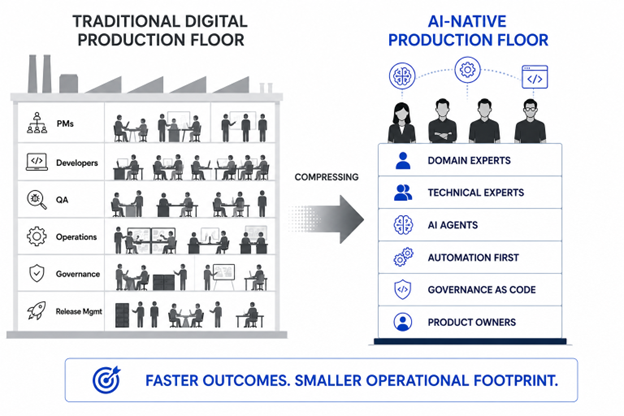
AI increasingly automates significant portions of those operational workflows. Not perfectly. Not completely. But enough to fundamentally change delivery economics.
Custom software engineering teams moving to AI vibe coding with AI agents are already seeing major operational gains. In many environments, delivery speed improvements of 40–70% are becoming realistic as AI agents support coding, testing, deployment orchestration, documentation, DevOps, and workflow automation. Some greenfield delivery teams are beginning to operate at the equivalent output of teams two to three times larger than before.
IMB reports that “AI, particularly generative AI (gen AI) and large language models (LLMs), streamline the development cycle by automating key steps, from idea generation and requirement gathering to coding and testing.”
Low-code platforms combined with AI agents are creating even larger operational compression for workflow-heavy systems. Internal applications, intake systems, approval workflows, reporting platforms, and operational dashboards can often be delivered 60–90% faster through AI-assisted low-code orchestration. In some cases, applications that historically required months of implementation can now be configured and deployed in days or weeks.
This is particularly disruptive in Government because the public sector has traditionally carried some of the highest operational friction in technology delivery:
- Complex approvals
- Fragmented systems
- Compliance overhead
- Procurement constraints
- Siloed operations
- Legacy infrastructure
- Extensive documentation requirements
Ironically, these are exactly the types of structured operational workflows AI agents are increasingly good at helping automate.
There is also an important distinction emerging between custom AI-native engineering and low-code AI-native workflow delivery.
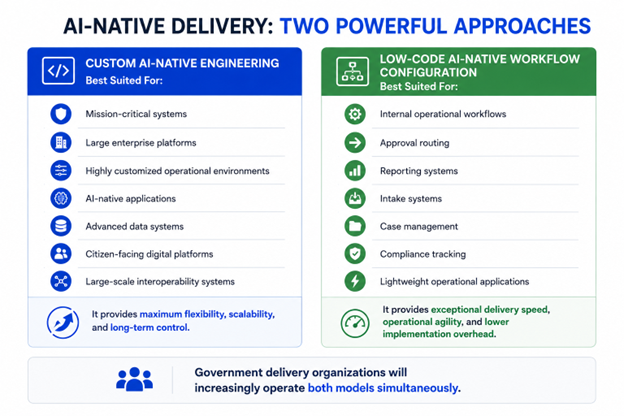
The strategic systems of Government will still require highly scalable custom engineering environments. But large portions of operational workflow delivery will increasingly move toward AI-assisted low-code managed service environments.
This creates a major shift in the structure of delivery organizations.
The future public sector delivery factory likely has:
- Fewer generalized developers
- Fewer manual coordinators
- Fewer large staffing hierarchies
- More automation architects
- More domain experts
- More AI orchestration
- More managed operational services
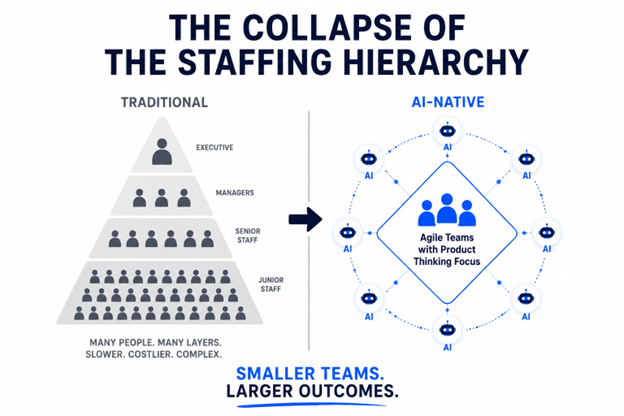
In many cases, the bottleneck is no longer writing software or configuring workflows. The bottleneck is understanding the mission and operational workflow well enough to automate it effectively. That is a very different marketplace (Reference first article: The End of the Traditional GovCon System Integrator) than the one traditional System Integrators were built for. And a much more domain or mission specific service.
In simpler terms:
The government is slowly moving from managing technology factories to buying operational outcomes. This will lead to the rise of AI-Native Outcome Integrators.
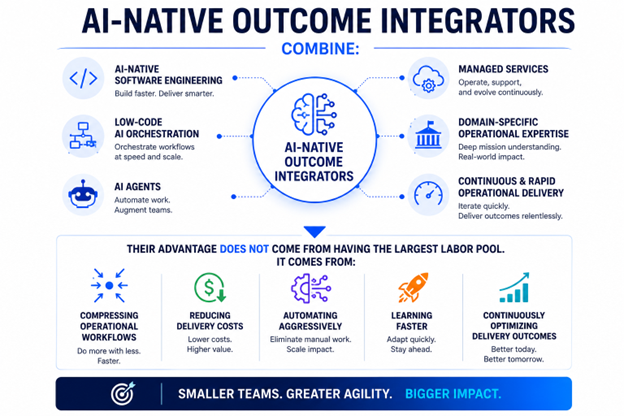
Smaller teams can now deliver larger operational outcomes. And perhaps most importantly, they learn faster. That learning speed matters because public services themselves are increasingly becoming dynamic systems rather than static applications. Deloitte recently described the future of government as operating through “continuous learning systems” with adaptive oversight, embedded feedback loops, predictive operations, and continuously evolving digital services.
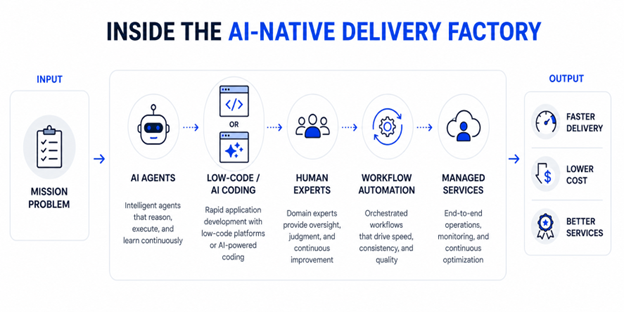
AI-native operational delivery allows workflows, policies, automations, and citizen experiences to evolve continuously instead of waiting for multi-year modernization cycles. The future public sector delivery factory is not simply “faster software development.” It is an operational model where:
- Workflows adapt continuously
- Automation scales aggressively
- Services personalize dynamically
- AI agents coordinate operational execution
- Domain experts shape delivery outcomes directly
This is the beginning of the AI-native public sector production floor. And many traditional GovCon System Integrators will make the mistake of treating AI like a coding assistant – instead of the disruptive shift in how systems are built. The AI-native Outcome Integrator is already designed for this disruptive shift.
See Part One: The End of the Traditional GovCon System Integrator
Part Three: Why Federal Acquisition Reform Favors AI-Native Outcome Integrators
About Greg Godbout
Greg Godbout is an AI and digital transformation executive helping government contractors and public sector organizations adopt and scale AI. He is the CEO of Flamelit, an AI and Data Science consultancy, and AI for Natural Disasters, an emergency response AI technology company. Both were recently acquired by Global Clean Energy, Inc. Previously, Greg served as Chief Growth Officer at Fearless, Chief Technology Officer and U.S. Digital Services Lead at EPA, and was the first Executive Director and Co-Founder of 18F. He is a Presidential Innovation Fellow, GSA Administrator’s Award recipient, and Federal 100 honoree. Greg holds master’s degrees from the University of Virginia and New York University in technology management, business analytics, and AI.