
Part 1 of a series: The Rise of AI-native Outcome Integrators
A traditional incumbent System Integrator enters a recompete feeling confident. The program office loves them, they know the environment, and they trim staffing slightly while adding a few AI features to meet the RFP requirements. Then an AI-Native Outcome Integrator wins the contract, because the GSA contracting office determines their AI-native delivery model can provide the same or better outcomes at roughly 70% of the cost. The incumbent is shocked, and the program office is skeptical at first – until they realize they are about to get faster delivery, higher quality services, and lower operational costs. Expect versions of this story to become increasingly common over the next few years.
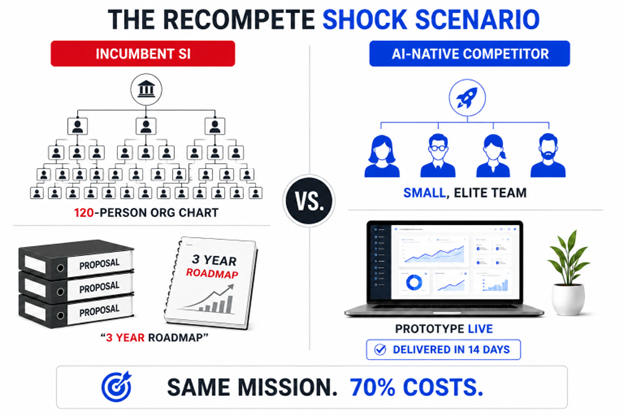
For the last 30 years, the GovCon marketplace has largely operated on a simple model:
Win contracts. Add people. Bill hours. Repeat.
That model built massive System Integrators, giant staffing hierarchies, and enough proposal infrastructure to qualify as its own Federal agency. Unfortunately for many traditional GovCon firms, AI just broke the economics behind that model. Further reinforced by the operational shift trending in government for years.
The most important change is this:
Government buyers will move from buying labor to buying outcomes – a shift accelerated by AI. That shift changes everything.
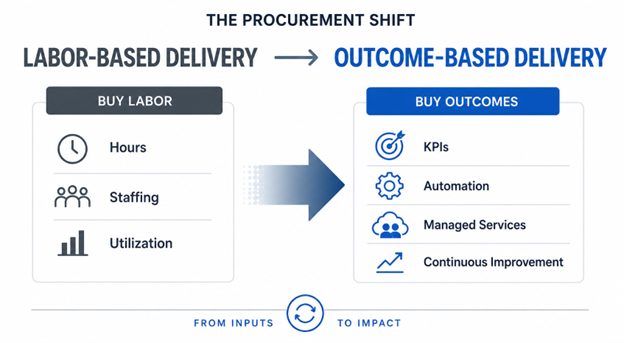
A relatively small AI-enabled team can now produce work that previously required much larger delivery organizations. AI agents are no longer just helping developers write code faster or low-code systems configure workflows faster. They are increasingly generating tests, automating workflows, documenting systems, orchestrating deployments, and supporting operational delivery.
The result is that the entire digital production floor is compressing. That is a problem for traditional staffing-heavy System Integrators whose business models depend on scaling labor.
AI is doing this to the GovCon marketplace, more and more directly. This is a disruptive innovation event. As Clayton Christensen described in The Innovator’s Dilemma, disruptive innovation does not only improve an industry. Rather, disruptive innovation changes the economics and operating model underneath an industry, allowing smaller, cheaper, and more agile competitors to displace incumbents that are hyper-optimized for the previous market structure.
AI-Native Outcome Integrators are not traditional SIs using better AI tools. They operate on a fundamentally different model built around smaller teams, AI-native workflows, automation-first operations, and continuously improving managed services designed to deliver measurable outcomes.
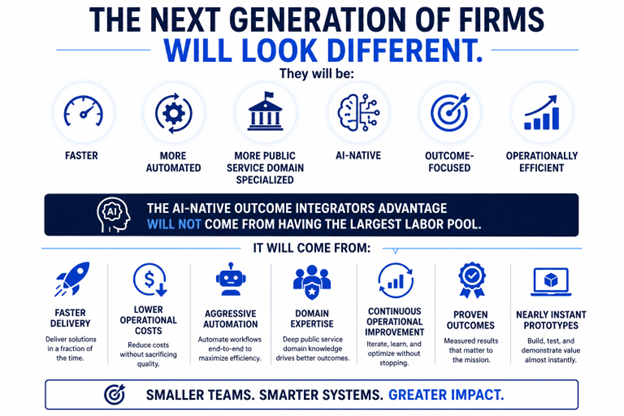
This creates a structural break. Traditional firms optimized for labor scale, proposal volume, and hierarchical delivery models cannot gradually evolve into AI-native operational businesses without fundamentally changing their incentives, pricing, staffing structures, and delivery assumptions. The shift is from selling labor capacity to delivering operational performance.
It requires a leap.
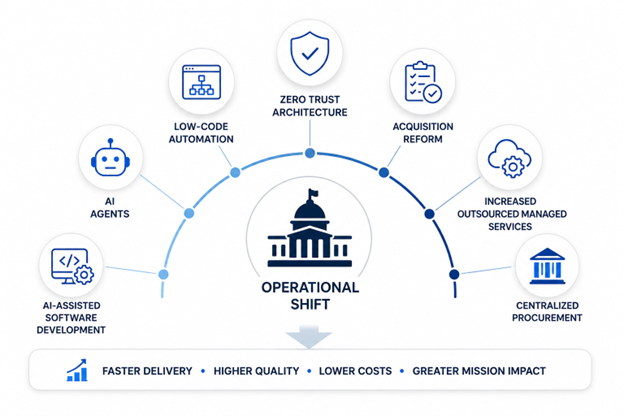
Federal acquisition trends are accelerating this disruption: centralized procurement, fixed-price contracts, managed services, budget pressure, and growing demand for “show me” prototypes instead of proposal-heavy competitions. Agencies increasingly want measurable outcomes — not larger staffing charts.
AI-native firms can now rapidly prototype, automate workflows, and deliver solutions faster and cheaper than traditional delivery models, creating major pricing pressure on legacy GovCon firms. At the same time, Zero Trust security (NIST) architectures are freeing up implementations from traditional perimeter-based network models. Growing federal workforce “brain drain” (Reuters) are increasing reliance on external partners with deep mission and operational expertise. The future advantage will increasingly belong to AI-Native Outcome Integrators specializing on public service domains – not labor-heavy system integrators.
Traditional GovCon firms still retain important advantages, including customer relationships, contract access, institutional knowledge, and operational scale. However, AI is beginning to dismantle one of the core assumptions that built the modern GovCon industry: that scaling digital services requires scaling labor at the same rate. That assumption is no longer true. AI-native firms can now deliver faster, more automated, and lower-cost outcomes with much smaller teams – creating pricing and operational advantages that will increasingly outweigh the perceived risk of moving away from traditional labor-heavy delivery models.
The shifts in government buying practices aligned with the efficiency and rapid delivery of an AI-native Outcomes Integrator – create a supply and demand pressure that edges out the Traditional GovCon firm. Leading to the Rise of the AI-native Outcome Integrator.
See Part Two: Inside the AI-Native Public Sector Delivery Factory
Part Three: Why Federal Acquisition Reform Favors AI-Native Outcome Integrators
About Greg Godbout
Greg Godbout is an AI and digital transformation executive helping government contractors and public sector organizations adopt and scale AI. He is the CEO of Flamelit, an AI and Data Science consultancy, and AI for Natural Disasters, an emergency response AI technology company. Both were recently acquired by Global Clean Energy, Inc. Previously, Greg served as Chief Growth Officer at Fearless, Chief Technology Officer and U.S. Digital Services Lead at EPA, and was the first Executive Director and Co-Founder of 18F. He is a Presidential Innovation Fellow, GSA Administrator’s Award recipient, and Federal 100 honoree. Greg holds master’s degrees from the University of Virginia and New York University in technology management, business analytics, and AI.